RAM 1500 VS RAM 2500: WHAT YOU ACTUALLY PAY FOR
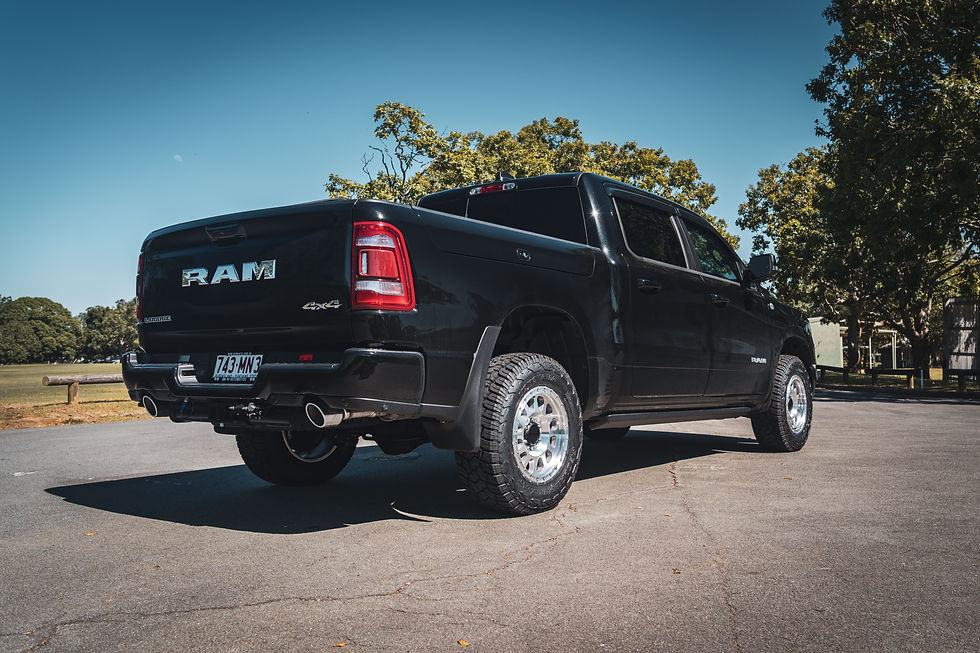
The RAM 1500 vs RAM 2500 debate looks like a tie on paper. Both claim a 4.5 tonne towing rating. One has a petrol engine, the other a big turbo diesel. So if the paperwork says they tow the same, what are you actually paying extra for? We had both on the hoist at our Brisbane workshop, so we went and had a proper look.
Prefer to watch instead of read? The video above runs through the same comparison with both trucks at our Brisbane workshop.
RAM 1500 vs 2500: GVM, Towing and Payload Compared
Spec | RAM 1500 | RAM 2500 |
Gross Vehicle Mass (GVM) | 3,505 kg | 4,495 kg |
Gross Combined Mass (GCM) | 7,711 kg | 12,750 kg |
Payload | 863 kg | 785 kg |
Category When Bought New | NB1 | NB1 |
Braked Towing Capacity | 4,500 kg | 4,500 kg |
On paper, these numbers don’t make sense. How does the bigger, tougher truck end up with less payload than the 1500? Here’s the catch. In Australia, a vehicle with a Gross Vehicle Mass (GVM) up to 4.5 tonne is classed as NB1, and you can drive it on a standard car licence.
Go over 4.5 tonne and you’re in the NB2 category, which needs a light rigid licence.

To keep buyers off that licence, RAM sells the 2500 as an NB1 from the factory, which means its GVM has been reduced to fit under the 4.5 tonne line. Because the 2500 is a heavier truck to begin with, that squeezed GVM leaves it with about the same payload as the 1500.
The 2500 isn’t weaker. It’s been held back on paper. Upgrade it to NB2 and you unlock the full potential of the truck, with far more payload and capacity. We’ll get to those numbers in the GVM upgrade section further down.
RAM 1500 vs 2500 Suspension: Independent Front End vs Solid Axle
The front end is where these two split ways. The 1500 uses independent front suspension, the same basic idea you'll find under a Toyota Corolla. Each side moves up and down on its own, with control arms doing the work. It's a very car-like setup.
The 2500 runs a solid front axle, the same style you'd find under an old-school Land Cruiser or Patrol. Solid axles are used where weight is the priority, which is why they sit under heavy-duty trucks. If you've never driven one, take a test drive first and get your head around how it behaves.

Both have a solid rear axle with coil springs, but that's where the similarities end. The 2500 has bigger diffs, bigger arms and absolutely enormous coils. We held a 1500 aftermarket rear coil next to a 2500 coil, and the size difference is wild. The 1500 is smaller everywhere, right down to the sway bar links. We've had a 1500 in the shed for a chassis brace, and that chassis can crack when it's towing near the factory 4.5 tonne rating. One customer found that out the hard way.
How They Drive: Petrol vs Diesel
The 1500 we drove was a Rebel, which is the off-road version. It has a factory one inch lift and a rear locker, which we hadn't seen on a RAM before. The V8 is gone, replaced by a twin turbo six-cylinder called the Hurricane. It's stupid quick off the line and feels faster than the old Hemi V8. It doesn't sound like a V8 though, and that's a little disappointing. The tow rating is still 4.5 tonne, but the Limited we drove drops to 4,200 kilos, which we put down to the full air suspension.
The 2500 has had a big glow up inside, with a proper centre console and a much more refined feel. It still has the 6.7 litre Cummins turbo diesel, now with more torque. For towing, it absolutely destroys the petrol engine on pulling power. The petrol can do the job, but if you're planning to tow for two or three years straight, the diesel does it with far less stress.
RAM 1500 GVM Upgrades in Brisbane
We're an accessory fitter and certified GVM installer, so we look after both trucks, from bullbars and canopies, roof racks and lighting. A GVM upgrade on the 1500 takes it to just under 4,000kg, with the GCM lifting to around 8.5 tonne and payload rising to roughly 1,330 kilos. Figures vary by variant. That gives you breathing room, but it still can't match what the 2500 is built for.
GVM Upgrade for 6th Gen RAM 2500
The 2500 is where it gets fun. Every stage in the Offroad Industries (ORI) program for the 6th generation RAM 2500 lifts GVM above 4.5 tonne, which pushes the truck into the heavier NB2 category. Learn more about what NB2 is here. Every stage keeps the 4,500 kilo braked towing capacity and the 12,750 kilo GCM. What changes is the GVM, the lift and the tyre size. Figures vary by variant.
Stage | Lift | Max tyre size | GVM (kg) | Payload (kg, approx.) |
Stage 1 | 2 inch | 35 inch | 5,500 | 1,740 |
Stage 2 | 2 inch | 35 inch | 5,890 | 2,120 |
Stage 3 | 3 inch | 37 inch | 5,890 | 2,060 |
Stage 4 | 4 inch | 37 inch | 5,890 | 2,060 |
Stage 5 | 6 inch | 37 inch | 5,890 | 2,060 |
Stage 6 | 6 inch | 40 inch | 5,800 | 2,060 |
RAM 1500 vs RAM 2500 Price: Is the Extra Spend Worth It?
Nobody likes talking about it, but it matters. In round numbers at the time of filming, a new 2500 was around $180,000 drive-away and a new 1500 around $150,000. Check current prices with your dealer. Whether that extra spend makes sense depends on your situation. If you need the heavy-duty truck with room to upgrade later, the 2500 earns its price. If you won't need that extra carrying and towing capacity, the 1500 will do the job.
Which RAM Should You Buy? Our Verdict
The 1500 is the little brother. It can occasionally do what the 2500 does, but you wouldn't want to live there every day. Be honest about what you'll actually use it for. Better yet, come and have a chat with the team before you buy, not after. Request a quote and we'll talk you through the right setup for your truck.